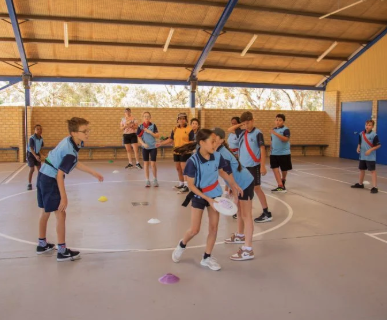
Your students run, kick, and throw every week during sport sessions. Yet many still struggle with balance, spatial awareness, and the kind of fluid movement that transfers across activities. The gap between showing up to sport and actually developing coordination is one of the most common challenges schools and OOSH centres face.
Often, the issue is not effort or enthusiasm. It is program design. Kids sports coaching coordination programs that follow a structured, multi-sport approach can close that gap. This guide walks you through exactly how to make it happen at your school or service.
You will find a breakdown of why so many coaching programs fall short, what the research says about motor skill development in children, and practical steps for designing sessions that genuinely build coordination. Along the way, you will see how inclusive, play-based frameworks help every child, not just the naturally athletic ones.
Key Takeaways: Kids Sports Coaching and Coordination
- Coordination develops through varied, multi-sport exposure rather than repetitive single-sport drills alone.
- Ages six to twelve represent a critical period when children respond most to coordination and motor skill training.
- Program design gaps such as limited movement variety and passive participation directly reduce coordination outcomes.
- No Limits Sports delivers structured multi-sport programs that build agility, balance, and coordination across OOSH and school settings.
- Inclusive coaching that adapts activities to all ability levels keeps every child moving, learning, and progressing.
What Is Coordination and Why Does It Matter for Children?
Coordination is the body's ability to integrate perception, decision-making, and physical action into smooth, controlled movement. For children, this means everything from catching a ball to changing direction mid-run to balancing on one foot.
It is not a single skill. Coordination includes balance, rhythm, spatial orientation, and the ability to react to visual and auditory cues. These elements work together as a system, and each one can be trained through the right kind of movement experiences.
According to a 2025 cross-sectional study published in the Journal of Functional Morphology and Kinesiology, children who participated in structured multisport play-based programs scored higher on motor coordination tests than peers in standard physical education. This finding reinforces something coaches and educators already observe: children who move in varied ways develop better overall movement control.
Why Many Kids Sports Coaching Programs Fail to Build Coordination
Many sports coaching sessions in school and OOSH settings focus on game play or single-sport skills. A typical session might involve a warm-up, some drills in one sport, and then a match. While this structure keeps children active, it often misses the building blocks of coordination.
The problem is threefold. First, single-sport sessions limit movement variety. A child who only practises soccer develops kicking and running patterns but may not develop throwing, catching, or rotational skills. Second, passive participation creeps in when sessions are not structured for maximum involvement, with children standing in lines or sitting out during games.
Third, sessions often lack progressive challenge. Coordination improves when activities move from simple to complex, from slow to fast, and from stable to unstable environments. Without deliberate progression, children plateau quickly. A coaching program that does not address all three of these gaps will keep kids moving without meaningfully developing their coordination.
How Reduced Play Affects Coordination in Australian Children
Before looking at solutions, it helps to understand the landscape. Australian children are spending less time in unstructured outdoor play than previous generations. A 2025 scoping review published in the Health Promotion Journal of Australia found that adherence to 24-hour movement behaviour guidelines among Australian children and adolescents ranged from just 2% to 22%.
This decline in overall movement has a direct connection to coordination. As Stuart McMillan, CEO of athletics coaching organisation ALTIS, wrote in an October 2025 article: "Kids don't play anymore. And because they don't play, they don't move enough, or in enough different ways, to build coordination."
For schools and OOSH centres, this means structured sports coaching is often the primary opportunity children have to develop these fundamental skills. The responsibility on program providers to get it right has never been greater.
The Critical Window: Ages Six to Twelve for Motor Skill Development
Research consistently highlights a sensitive period for coordination development, roughly between the ages of six and twelve. During this window, children's nervous systems are especially responsive to varied movement stimulation.
Coordination expert Joseph Drabik has noted that the most crucial period falls between ages ten and thirteen, with significant responsiveness beginning as early as age seven. A 2025 case study comparing athletics-only training to multiactivity training in children aged six to ten found that the group exposed to multiple sports showed greater improvement in eye-hand coordination, a key coordination component.
This evidence carries a practical message for anyone running programs in primary schools or OOSH settings. The children in your care are in the optimal period for coordination development. Programs that expose them to varied sports and movement challenges during these years create a foundation that lasts well beyond childhood.
What Effective Program Design Looks Like for Coordination
Designing a coaching program that genuinely builds coordination requires intentional structure. It goes beyond choosing a sport and running drills. Here is what the evidence and best practice suggest.
Prioritise Multi-Sport Exposure Over Single-Sport Repetition
Children benefit from exposure to different sports and movement patterns. A program that rotates through soccer, basketball, gymnastics, martial arts, dance, and athletics across a term gives children a broader movement vocabulary than one that sticks to a single activity.
No Limits Sports builds this principle into every OOSH and school program. Their multi-sport sessions cycle through throwing, catching, kicking, striking, balance, and coordination, ensuring children develop transferable skills rather than narrow, sport-specific habits.
Design Sessions With Progressive Challenge
Coordination improves when activities become gradually more demanding. Start with tasks that require good spatial awareness at low speed, then increase tempo and environmental complexity over time.
A practical example: in week one, children practise balancing on one foot while stationary. By week four, they balance while catching a ball thrown from different angles. By week eight, they balance, catch, and pivot to pass under time pressure. This kind of progressive layering builds real coordination, not just repetition.
Maximise Active Participation Time
Every minute a child spends standing in a line or waiting for a turn is a missed opportunity. Effective programs use small-group rotations, partner activities, and modified games that keep all children moving simultaneously.
When No Limits Sports coaches work with groups of up to 80 children, they use multiple stations and rotating activities to ensure every child stays active. This approach is especially important in OOSH and vacation care settings where group sizes can be large and attention spans short.
Embed Coordination Tasks Into Every Session Component
Coordination work should not be a standalone drill segment that children sit through before the "real" activity. Balance challenges can be woven into warm-ups. Rhythm and reaction exercises can be part of transitions between activities. Spatial awareness tasks can be embedded in game play.
This integrated approach means coordination development happens throughout the entire session, not just in one isolated block. It also makes sessions feel more dynamic and engaging for children.
The Role of Play and Unstructured Movement in Coordination
Structured coaching and free play are not competing approaches. They are complementary. Research shows that unstructured play naturally trains coordination capacities such as timing, rhythm, and spatial awareness, often more effectively than formal drills alone.
The best coaching programs leave room for play within their structure. Tag games, dodgeball variations, obstacle courses, and creative movement challenges all develop coordination while feeling like pure fun for children.
For OOSH and vacation care settings, blending structured multi-sport coaching with play-based elements creates sessions that children genuinely look forward to. This combination keeps engagement high while ensuring coordination outcomes are built into every session.
How Inclusive Coaching Supports Coordination for Every Child
Coordination development is not only for naturally athletic children. Every child, regardless of ability level, benefits from programs that challenge them appropriately and adapt to their needs.
Inclusive program design means offering modifications so that a child with lower coordination can participate meaningfully alongside peers who are more advanced. It also means avoiding elimination games where the least coordinated children are the first to sit out.
No Limits Sports coaches specialise in inclusive delivery across all school types, including special schools and support units. Their sessions are tailored to each group's abilities, ensuring that every child is actively building coordination rather than watching from the sidelines. This inclusive approach reflects their commitment to every child's right to engage in play and develop their sporting ability.
Step-by-Step Guide to Designing a Coordination-Focused Program
Whether you are a PE teacher, OOSH coordinator, or vacation care manager, this step-by-step framework will help you design or evaluate a sports coaching program with coordination at its core.
Step 1: Audit Your Current Program for Movement Variety
List every sport and activity type offered across a full term. Count how many different fundamental movement skills are covered: throwing, catching, kicking, striking, balancing, jumping, rolling, and dodging. If your program covers fewer than five of these regularly, it needs more variety.
Step 2: Map Activities to Coordination Components
Coordination is not one thing. It includes balance, rhythm, spatial orientation, reaction time, and body control. Map your current activities against these components. You may find that your program develops balance well but neglects rhythm or reaction training.
Step 3: Build Progressive Difficulty Into Each Term
Structure your term so that activities increase in complexity over time. Early weeks should focus on foundational movements at moderate speed. Middle weeks introduce dual-task challenges such as balancing while throwing. Later weeks add time pressure, unpredictable elements, and team-based coordination tasks.
Step 4: Minimise Passive Time in Every Session
Review your session plans and identify any moment where children are waiting, watching, or sitting. Replace lines with partner drills. Replace elimination games with continuous-play alternatives. Aim for 80% or higher active participation time in every session.
Step 5: Include Both Structured and Play-Based Elements
Divide sessions into structured skill development and open play segments. A 60-minute session might include 15 minutes of warm-up games targeting balance and reaction, 25 minutes of sport-specific skill work with embedded coordination challenges, and 20 minutes of modified games or free play.
Step 6: Train Coaches to Observe and Adapt
Coaches need the ability to read a group and adjust on the spot. If children are finding a drill too easy, add a constraint like using the non-dominant hand. If they are struggling, simplify. The best coordination outcomes come from activities pitched at the right level of challenge for each group.
Step 7: Evaluate and Adjust Each Term
At the end of each program cycle, assess which activities worked well and which fell flat. Gather feedback from educators and observe children's movement quality. Use this information to refine the next term's program, keeping what builds coordination and replacing what does not.
What to Look for When Choosing an External Coaching Provider
Many schools and OOSH centres partner with external providers to deliver sports coaching. If you are evaluating providers, here are the features that indicate a program will genuinely build coordination.
Look for providers that offer multi-sport programs rather than single-sport options. Ask whether their sessions include progressive difficulty across a term. Check that coaches hold relevant qualifications, Working With Children checks, and have experience working with the age group and abilities at your centre.
Flexibility matters too. A provider should be willing to tailor sessions to your group's needs, your available space, and your goals. No Limits Sports, for example, delivers programs across every state and territory in Australia, covering metro and regional areas, with sessions adapted to suit everything from small OOSH groups to full school cohorts.
How Vacation Care Programs Can Prioritise Coordination
Vacation care presents a unique opportunity. With longer sessions and more relaxed scheduling, care providers can offer the kind of extended, varied movement experiences that term-time constraints often limit.
Multi-sport incursions during holiday periods let children try activities they may not access during the school year. Sessions combining elements of martial arts, gymnastics, dance, and team sports introduce movement patterns that challenge coordination in fresh ways.
No Limits Sports vacation care incursions include options like Multi-Sport Mania, Mini Olympics, and Traditional Indigenous Games, each designed to develop agility, balance, and coordination while keeping the holiday atmosphere fun and engaging. Their coaches bring all equipment and manage session delivery, so your team can focus on caring for the children.
Funding Options That Make Coordination Programs Accessible
Cost can be a barrier to running high-quality sports programs. Understanding the funding options available helps schools and OOSH centres access the programs their children need.
The Australian Government's Sporting Schools program provides funding for eligible schools to deliver sporting programs. No Limits Sports is registered with Sporting Schools, making it straightforward for schools to use this funding for multi-sport coordination-focused programs.
For OOSH centres, No Limits Sports offers two flexible funding models: service-funded, where the centre pays a set weekly cost, and parent-funded, where families register and pay directly through a dedicated booking link. Both options keep administration simple and reduce the financial barrier to delivering consistent, quality coaching. You can find answers to common questions on the No Limits Sports FAQ page.
Measuring Coordination Progress in Your Program
You do not need laboratory equipment to track coordination development. Simple observation-based assessments can help you see whether your program is making a difference.
Watch for improvements in movement quality over a term. Can children balance for longer? Are they catching more consistently? Do they change direction more fluidly during games? These observable markers give you practical evidence of coordination growth.
Asking coaches to note specific observations after each session builds a record over time. You might track how many children can complete a balance challenge in week one versus week eight, or whether passing accuracy in modified games improves across the term.
Common Mistakes Schools and OOSH Centres Make With Coordination Programs
Even well-intentioned programs can fall short. Here are the most common pitfalls to avoid.
Relying on a Single Sport All Term
Running the same sport every week limits the range of movements children experience. Rotate sports or use a multi-sport format to maximise movement variety and coordination development.
Treating Coordination as an Add-On Rather Than a Core Goal
Coordination should be woven into every session, not bolted on as an afterthought. When it is the primary design principle, every activity contributes to motor skill development.
Overlooking Children Who Are Less Coordinated
Children who struggle with coordination often need the most support but receive the least in traditional coaching settings. Inclusive design, adapted activities, and encouraging coaching ensure these children stay engaged and improve over time.
Choosing Providers Based on Cost Alone
A lower-cost provider that runs passive, single-sport sessions delivers less value than a structured program that builds genuine coordination outcomes. Evaluate providers on their program design, coach qualifications, and ability to adapt to your setting.
In Conclusion: Building Coordination Through Intentional Program Design
Coordination does not develop by accident. It requires programs that prioritise movement variety, progressive challenge, maximum participation, and inclusive delivery. For schools and OOSH centres, the window of opportunity is open right now, during the primary school years when children are most responsive to motor skill development.
By auditing your current programs, choosing multi-sport approaches, and partnering with qualified providers who understand coordination development, you give every child in your care the foundation for confident, capable movement across any sport or activity they take on.
If you are ready to bring structured, coordination-focused sports coaching to your school or OOSH centre, get in touch with No Limits Sports to discuss how their experienced coaches can support your goals.
FAQs About Kids Sports Coaching and Coordination
What is the best age for children to develop coordination through sport?
Children between the ages of six and twelve are in a sensitive period for coordination development. During these years, their nervous systems respond strongly to varied movement stimulation. Starting multi-sport coaching early in this window helps build a broad coordination foundation that supports future athletic and physical development.
Why do single-sport programs limit coordination development?
Single-sport programs train a narrow range of movement patterns. Coordination requires balance, rhythm, spatial awareness, and reaction skills developed through diverse activities. Children who only practise one sport may develop strong sport-specific skills while missing the broader movement capabilities that transfer across all physical activities.
How does No Limits Sports build coordination into their coaching programs?
No Limits Sports structures every session around multi-sport exposure, embedding throwing, catching, kicking, balancing, and striking activities into each program. Their qualified coaches tailor sessions to all abilities and use progressive difficulty across each term, ensuring children develop agility, balance, and coordination in every session rather than focusing on game play alone.
Can coordination coaching work in large OOSH or vacation care groups?
Yes. Effective coordination coaching in large groups uses station rotations, partner activities, and modified games to keep every child moving simultaneously. No Limits Sports coaches regularly work with groups of up to 80 children, using multiple stations and adapted activities to maintain high active participation and meaningful coordination development for every child.
How can schools fund coordination-focused sports programs?
Australian schools can access funding through the government's Sporting Schools program, which supports eligible schools in delivering structured sports coaching. No Limits Sports is registered with Sporting Schools, making it straightforward to use this funding for multi-sport coordination programs. OOSH centres can choose between service-funded or parent-funded models to keep costs manageable.
Tags: