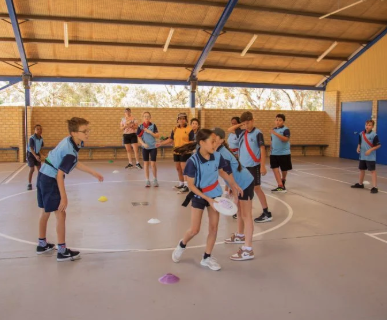
Basketball is one of the most effective sports for developing agility and coordination in kids. The quick stops, fast pivots and constant direction changes make it a natural fit for schools and OOSH centres looking to build physical skills through structured activity. No Limits Sports delivers basketball coaching programs designed to get kids moving, build confidence and develop coordination across every session.
If you are running a school PE program or coordinating activities for an OOSH centre, basketball gives you a proven, engaging way to develop agility. The activities below are practical, adaptable and ready to run in your next session.
Key Takeaways: Basketball Activities That Build Kids' Agility
- Basketball activities develop agility, coordination and balance in kids through frequent direction changes and fast footwork.
- Cone drills and ladder patterns build body control that transfers directly to other sports and physical activities.
- Reactive drills like mirror shuffles teach kids to respond quickly, improving on-court and off-court awareness.
- No Limits Sports provides qualified coaches who deliver basketball agility programs tailored to all abilities.
- Short, focused agility blocks of ten to fifteen minutes are more effective than longer, unstructured sessions.
Basketball Activities for Building Kids' Agility and Coordination
1. Dribble Weave Through Cones
Set up six to eight cones in a zigzag pattern across your court or play area. Kids dribble through the cones, switching hands at each turn. This activity trains lateral movement, hand-eye coordination and the ability to change direction while controlling the ball.
Start at walking pace so younger kids can find the rhythm. As confidence grows, encourage faster movement with a lower body position. You can time each run to give kids a personal target to beat next session, which adds a competitive element they enjoy.
2. Defensive Slide Relay
Split your group into teams lined up behind a baseline. Each player slides laterally across the court in a defensive stance, touches the sideline and slides back. The next player goes when the previous one returns.
This relay develops hip mobility, lateral quickness and competitive energy. Kids stay low, keep their feet wide and learn to push off the outside foot with each change of direction. It works well for groups of all sizes, keeps every child actively engaged between turns, and requires nothing more than a court with sidelines.
3. Partner Mirror Shuffle
Pair kids up and have them face each other in a low athletic stance. One player leads by shuffling left and right at random. The other mirrors every movement as quickly as possible. Swap roles every twenty seconds so both kids practise leading and reacting.
Mirror drills build reactive agility because kids respond to a real person instead of a predictable cone. This is the closest a drill gets to actual game movement and teaches coordination and teamwork at the same time.
4. Agility Ladder Footwork Patterns
Lay an agility ladder flat on the ground. Kids move through it using patterns like two feet in each box, lateral shuffles or the icky shuffle. Each pattern targets different footwork skills and keeps sessions fresh from week to week.
Agility ladders teach rhythm, quick ground contact and accurate foot placement. They are portable, inexpensive and work in any space. According to a 2025 study published in the Journal of Physical Education and Sport, targeted coordination drills integrated into basketball training produced significant improvements in balance, rhythm and spatial orientation in young athletes.
5. Cone Reaction Sprint
Place four cones in a square about three metres apart. One child stands in the middle in a ready position. A coach or partner points to a cone, and the child sprints to touch it before returning to the centre. Keep going for twenty to thirty seconds, then rotate.
Reaction drills are valuable because kids cannot predict what comes next. They stay low, stay alert and build the explosive first step that matters in basketball and other sports. This activity suits all ages and can be scaled easily for larger groups.
6. Figure-Eight Dribble
Set two cones about three metres apart. Kids dribble in a figure-eight pattern around both cones, staying as low and fast as possible. Count how many loops they complete in thirty seconds and challenge them to improve each session.
This drill combines acceleration, deceleration and turning into one continuous movement. Adding a basketball makes it a ball-handling drill too, which gives coordinators flexibility to cover multiple skills in one short activity block. It works just as well in a small indoor space as on a full court.
7. Jump Stop and Go
Kids dribble at full speed down the court. On the coach's whistle, they perform a jump stop, hold a balanced position for two counts, then explode forward again. Repeat three to four times across the full length of the playing area.
Deceleration is half of agility, and most kids only practise the acceleration part. This activity teaches controlled stopping, body awareness and the ability to restart quickly. It translates directly to game situations where players need to stop, pivot and react.
8. Shuttle Dribble Drill
Line up five cones in a straight row, each about two metres apart. Kids dribble up two cones, back one, up two, back one, tapping each cone with their free hand. They continue this pattern all the way to the end.
Shuttle dribbling builds endurance alongside agility. The constant forward-and-back movement strengthens the ability to change direction without losing speed or ball control. It also keeps groups occupied because several children can run the pattern on parallel lanes at once.
9. Lateral Bound and Stick
Kids stand on one leg, bound laterally to the opposite foot, and hold the landing for two seconds before bounding back. Each "stick" landing trains single-leg stability and the ability to absorb force through the ankle, knee and hip.
A 2026 study in BMC Sports Science, Medicine and Rehabilitation found that sprint speed and vertical jump power are key determinants of agility in young basketball players aged six to thirteen. Lateral bounds develop exactly those qualities in a simple, equipment-free format.
10. Basketball Tag
Every child gets a basketball and dribbles inside a defined area. One or two players are "taggers" who must tag other players while still dribbling their own ball. If you are tagged, you do five jumping jacks and re-enter the game.
Basketball tag turns agility training into a game, which keeps engagement high and makes the session feel less like a formal drill. Kids practise spatial awareness, dribbling under pressure and rapid direction changes, all while having fun with their friends.
How to Bring Basketball Agility Activities to Your School or OOSH Centre
Choosing the right basketball agility activities depends on your group size, available space and the age of the children. Start with two or three activities per session, keep each block to ten or fifteen minutes, and rotate activities across the week to maintain variety.
No Limits Sports makes it easy to bring structured basketball coaching to your school or OOSH centre. Our qualified coaches handle everything from equipment and session planning to insurance and Working With Children checks, so you can focus on your students. Programs run across every state, in metro and regional locations, and can be tailored to your timetable and funding options.
Get in touch with the No Limits Sports team to discuss how basketball agility programs can work for your centre.
FAQs About Basketball Agility Activities for Kids
What age group benefits most from basketball agility activities?
Children aged six to thirteen respond well to basketball agility training because their motor learning capacity is heightened during this period. Activities can be simplified for younger children and made more challenging for older groups.
How often should kids do basketball agility drills?
Two to three short sessions per week produce the strongest results during term-time programs. Each agility block should last ten to fifteen minutes and focus on quality movement rather than volume.
Do you need special equipment for basketball agility training?
Most activities require only basketballs and a few cones. Agility ladders and line markers are useful additions but not essential. No Limits Sports provides all equipment as part of its coaching programs.
Can basketball agility activities work indoors?
Yes. Every activity listed above can be run in a hall, gymnasium or covered outdoor area. Indoor delivery makes basketball agility training reliable regardless of weather conditions.
How does basketball improve coordination in children?
Basketball requires constant transitions between dribbling, passing, pivoting and sprinting. These combined movements develop hand-eye coordination, spatial awareness and the ability to control the body through rapid direction changes.
Can No Limits Sports deliver basketball agility programs at our centre?
No Limits Sports delivers basketball coaching programs to schools and OOSH centres across Australia. Programs are tailored to your group size, age range and available space, with qualified coaches who bring all equipment and manage session logistics.
Tags: